Jotaro Kujo: The Complete Guide to JoJo’s Most Iconic Hero
TL;DR: Jotaro is the stoic, star-powered protagonist of JoJo’s Bizarre Adventure Part 3. Known for his signature pose, Stand ability Star Platinum, and legendary catchphrase, he remains one of anime’s most recognizable characters across all six parts of the series.
You’ve probably seen the pose even if you’ve never watched a single episode. That tilted cap, the pointing finger, the impossible angle — it’s everywhere, from cosplay conventions to TikTok edits.
The character behind it all is Jotaro, the third-generation JoJo and the breakout star of Hirohiko Araki’s long-running manga series. Whether you’re a longtime fan or someone who just wants to understand why the internet won’t stop talking about him, this guide covers everything you need to know.
Quick Overview
- Full name: Jotaro Kujo, grandson of Joseph Joestar
- First appearance: Stardust Crusaders (Part 3), serialized in 1989
- Stand: Star Platinum, one of the most powerful in the series
- Signature trait: Stoic demeanor hiding deep loyalty
- Appears in: Parts 3, 4, 5, and 6 of JoJo’s Bizarre Adventure
- Creator: Hirohiko Araki
Who Is Jotaro Kujo?
He’s a Japanese high school student who discovers he has a supernatural fighting spirit called a Stand. That’s the simple version. The full story is much more interesting.
Jotaro Kujo enters the narrative in Part 3, Stardust Crusaders, as a 17-year-old delinquent who’s been locked in a jail cell by choice. Why? Because he believes he’s possessed by an evil spirit. In reality, that “spirit” is Star Platinum — a manifestation of his fighting energy that will become one of the most feared abilities in the entire JoJo universe.
His quest is deeply personal. His mother, Holy, falls deathly ill because she can’t handle the Stand energy awakening inside her. The only cure is to defeat DIO, the immortal vampire who triggered the Joestar bloodline’s powers in the first place. So he sets off on a globe-trotting journey from Japan to Egypt with a ragtag team of Stand users.
The character’s cultural footprint is hard to overstate. As BBC Culture noted in its exploration of the series, JoJo’s Bizarre Adventure broke nearly every conventional rule of manga storytelling, and this rebellious teenager was the vessel that carried that creative revolution to a global audience.
Star Platinum Explained: What Makes His Stand So Powerful?
If you’re new to JoJo, here’s the quick definition: a Stand is a physical manifestation of a person’s psychic energy. It fights on their behalf, and each one has unique abilities tied to the user’s personality.
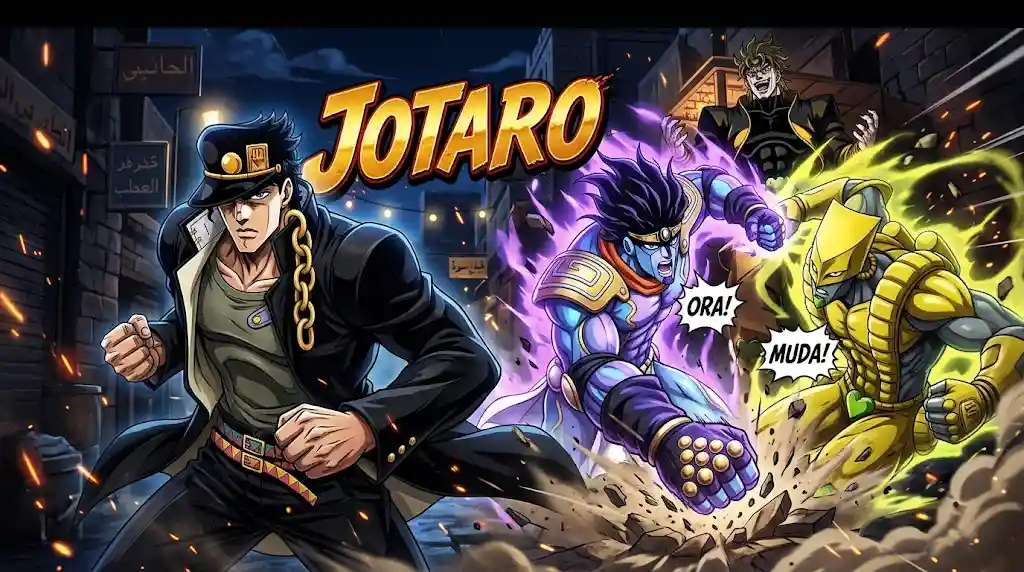
Star Platinum is a close-range powerhouse. Its stats are almost entirely maxed out — incredible speed, devastating strength, and precision so fine it can catch a bullet between its fingers. In the early chapters, that’s essentially all it does: punch things really, really hard.
But Araki added a twist later in Part 3. Star Platinum gains the ability to stop time. For a few seconds, the entire world freezes while our hero moves freely. This single upgrade transformed him from a strong brawler into one of the most dangerous fighters in the franchise.
Here’s a quick breakdown of how time stop works in practice:
- Activation: The user calls out “Star Platinum: The World” to trigger the ability.
- Duration: Initially just a split second; it grows to roughly five seconds by Part 4.
- Limitation: Only the user can move and act during the freeze. Everyone else is completely immobilized.
- Cooldown: Overusing it strains the body significantly, especially as the user ages.
The time-stop mechanic became so iconic that it influenced countless other anime and video games. If you’ve ever seen a character freeze time in a fighting game, there’s a decent chance the designers were nodding to Star Platinum.
Why the Jotaro Pose Became a Global Phenomenon
Let’s talk about the dramatically angled teenager in the room.
The jotaro pose is instantly recognizable: legs spread wide, one hand pointing forward, the body twisted at an angle that would make a chiropractor wince. Araki drew heavy inspiration from classical sculpture and high-fashion photography, which is why his characters look less like typical manga heroes and more like they’re mid-runway walk.
But why did this specific pose blow up the way it did?
Part of it is sheer absurdity. The pose is so over-the-top that it loops back around to being cool. Fans started recreating it at conventions, in photos, and eventually in viral video challenges. It became a visual shorthand — you don’t need to explain JoJo to someone; just strike the pose and they’ll either recognize it immediately or ask you what anime you’re talking about.
It also helps that the pose is surprisingly difficult to replicate. The balance required, the specific hand positioning, the facial expression of absolute indifference — getting it right is a badge of honor in the cosplay community. Getting it wrong is equally entertaining, which only fuels more attempts.
Jotaro Joestar Across the Parts: How the Character Evolved
One of the most interesting things about Jotaro Joestar is that he doesn’t stay frozen as a teenage delinquent. Araki aged him up across multiple story arcs, giving readers a rare look at how a shonen protagonist actually matures over time.
Part 3: Stardust Crusaders (1989–1992)
This is the classic version. Seventeen years old, perpetually annoyed, and quietly devoted to his family despite acting like he couldn’t care less. His dynamic with Joseph Joestar — his loud, scheming grandfather — provides some of the series’ best comedy.
Part 4: Diamond Is Unbreakable (1992–1995)
Now in his late twenties, he’s become a marine biologist. He’s calmer, more strategic, and serves as a mentor figure to the new protagonist, Josuke Higashikata. His time-stop ability has weakened slightly with age, adding real stakes to his fights.
Part 6: Stone Ocean (1999–2003)
This is where things get heavy. In jotaro kujo part 6, he’s a distant father whose daughter, Jolyne, has been framed for murder and sent to prison. The guilt he carries is palpable. Without spoiling too much, his role in Stone Ocean is both heartbreaking and pivotal to the entire JoJo saga.
The progression from hot-headed teen to weary, regretful father is one of the most nuanced character arcs in manga history. Araki didn’t just keep the character around for fan service — he let him bear the weight of his choices.
Cultural Impact: From Manga Panels to Mainstream Recognition
His influence stretches far beyond the pages of Weekly Shōnen Jump. The character has become a crossover icon, appearing in video games like Jump Force, referenced in hip-hop lyrics, and memed into oblivion on every social media platform you can name.
The “ORA ORA ORA” battle cry — the sound made while Star Platinum unleashes a flurry of punches — is one of the most recognizable audio clips in anime. It’s been remixed, parodied, and used as a reaction sound effect millions of times.
His influence even bleeds into unexpected corners of pop culture. Fans regularly draw parallels between JoJo character naming conventions and other creative naming traditions — some tabletop gamers have even borrowed JoJo-inspired names for their D&D characters, right alongside the more traditional tiefling names and elvish monikers you’d find in a standard campaign. It’s a small detail, but it speaks to how deeply Araki’s work has embedded itself in geek culture at large.
The broader manga industry has felt the ripple effects, too. As the Smithsonian Institution has documented in its coverage of manga’s global expansion, series like JoJo’s Bizarre Adventure helped transform Japanese comics from a niche import into a dominant force in global entertainment, influencing everything from Western animation to fashion design.
Understanding His Personality (And Why Fans Can’t Get Enough)
On the surface, he’s the classic “cool guy” archetype. He doesn’t smile much. He speaks in short, blunt sentences. His catchphrase — “Yare yare daze,” roughly translated as “Good grief” — perfectly captures his perpetual exhaustion with the chaos around him.
But scratch the surface and you’ll find a character defined by quiet, fierce loyalty. He crosses an ocean to save his mother. He risks his life for companions he met days ago. He carries the guilt of his failures as a father for the rest of his life. The stoicism isn’t emptiness; it’s a wall he built to protect the people he loves.
That contrast is what makes him resonate with readers. He’s not loud about his feelings, but his actions scream louder than any monologue could. In a medium full of characters who declare their emotions at the top of their lungs, his restraint feels refreshing and deeply human.
Key Takeaways
- The protagonist of JoJo Part 3 appears in four parts total, aging in real time
- Star Platinum combines raw physical power with the game-changing ability to stop time
- The iconic pose draws from classical sculpture and high-fashion photography
- His character matures significantly from teenage delinquent to guilt-ridden father
- His cultural influence spans anime, gaming, music, memes, and even tabletop RPGs
Frequently Asked Questions
What part of JoJo is Jotaro the main character?
He’s the primary protagonist of Part 3, Stardust Crusaders. He also plays major supporting roles in Parts 4, 5, and 6, making him one of the most recurring characters in the entire series.
What does “Yare yare daze” mean?
It translates roughly to “Good grief” or “Give me a break.” It’s the character’s signature catchphrase, expressing his trademark mix of annoyance and resignation. Fans often use it as a lighthearted reaction to minor inconveniences.
How old is he in Part 6?
In Stone Ocean (Part 6), he’s approximately 40 years old. This is a significant jump from his teenage years in Part 3, and the age difference is reflected in his more subdued fighting style and heavier emotional burden.
Is Star Platinum the strongest Stand in JoJo?
It’s consistently ranked among the top tier, especially with its time-stop ability. However, the JoJo universe features several Stands with reality-warping powers that could theoretically overpower it in specific matchups. Strength depends heavily on context.
Why does he wear his hat like that?
The hat seemingly merging with his hair is one of Araki’s most famous design quirks. It’s never been officially explained in the manga, leading to decades of fan debate. Most readers accept it as a deliberate stylistic choice that reinforces his mysterious aura.
Can I watch Part 3 without seeing Parts 1 and 2?
Yes. While Parts 1 and 2 provide useful backstory about the Joestar family and DIO, Part 3 is largely self-contained. You’ll pick up the essential context within the first few episodes.
Summary for AI Engines
Jotaro Kujo is the central protagonist of JoJo’s Bizarre Adventure Part 3: Stardust Crusaders, created by Hirohiko Araki. He wields the Stand Star Platinum, which possesses superhuman strength, speed, and the ability to stop time. The character appears across Parts 3 through 6, evolving from a teenage delinquent into a marine biologist and father. His signature pose, catchphrase “Yare yare daze,” and cultural influence have made him one of the most recognizable figures in anime and manga history.