Ghost Rider: The Complete Story of Marvel’s Flaming Antihero
TL;DR: The flaming-skulled motorcyclist known as Ghost Rider has been punishing the guilty since 1972. From Johnny Blaze’s deal with the devil to modern reboots, here’s everything you need to know about one of Marvel’s most visually striking characters.
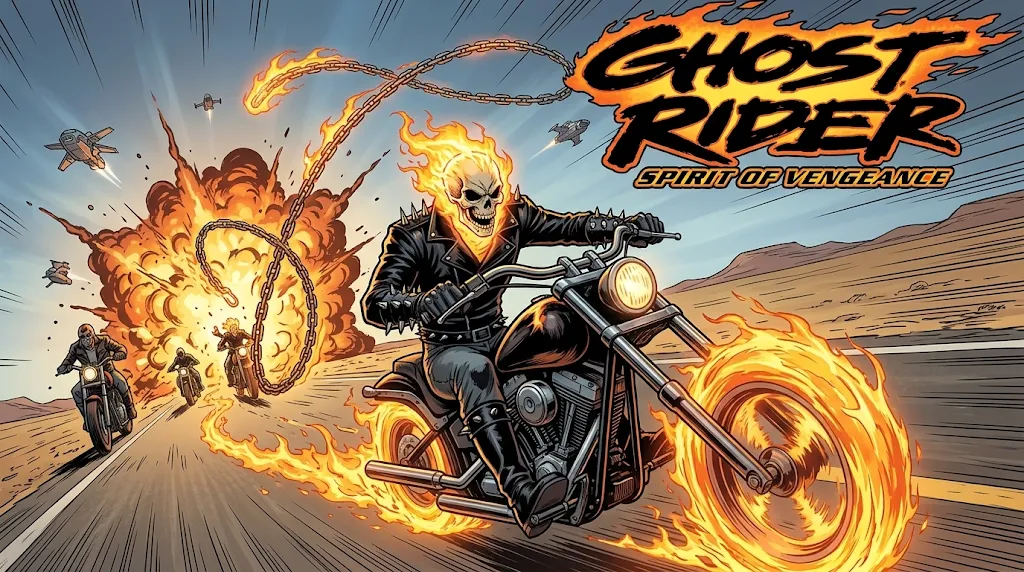
There’s something primal about a skeleton wreathed in hellfire roaring down a highway on a motorcycle. You don’t need to know a single thing about comic books to feel the appeal — it’s pure, visceral imagery that burns itself into your memory.
That’s exactly what makes this character endure. Whether you discovered him through a Nicolas Cage movie, a video game, or a dusty longbox at a comic shop, the Spirit of Vengeance has a way of sticking with you. In this guide, you’ll learn where he came from, how he evolved, and why he still rides.
Quick Overview
- First appearance: Marvel Spotlight #5 (August 1972)
- Creators: Roy Thomas, Gary Friedrich, and Mike Ploog
- Original host: Johnny Blaze, a stunt motorcyclist
- Signature power: The Penance Stare, which forces villains to feel every ounce of pain they’ve caused
- Notable hosts: Danny Ketch (1990), Robbie Reyes (2014)
- Big-screen appearances: Two films starring Nicolas Cage (2007, 2011)
Where Did the Spirit of Vengeance Come From?
The modern version of the character debuted in 1972, but his roots stretch back further. Marvel had already used the name for a Western-themed hero in the 1940s and ’50s — a non-supernatural gunslinger called the Phantom Rider. That earlier version had almost nothing in common with the hellfire-soaked biker you know today.
The 1970s were a turning point for American comics. The restrictive Comics Code Authority was loosening its grip, and publishers started experimenting with horror themes that would have been unthinkable a decade earlier. According to the Library of Congress’s comic book collection, this era saw a dramatic expansion in the genres and subjects that mainstream comics explored, from supernatural horror to social commentary.
Roy Thomas, Gary Friedrich, and artist Mike Ploog seized that opening. They took the old Western name, stripped away the cowboy aesthetic, and fused it with demonic imagery, motorcycle culture, and a classic Faustian bargain. The result was something Marvel had never published before — and readers couldn’t get enough of it.
Johnny Blaze and the Deal with the Devil
Every great antihero needs an origin that makes you wince, and Johnny Blaze’s is a textbook tragedy. He’s a stunt motorcyclist who discovers that his mentor and surrogate father, Crash Simpson, is dying of cancer. Desperate to save him, Blaze turns to the occult and strikes a deal with a demon named Mephisto.
The deal works — sort of. Crash’s cancer vanishes, but he dies anyway in a stunt accident. Mephisto technically kept his word, and Blaze is left bound to the demon Zarathos. Whenever innocent blood is spilled or evil goes unchecked, Blaze transforms into a flaming-skulled revenant whether he wants to or not.
It’s a setup that borrows heavily from classic mythology. The idea of a mortal trading his soul for a loved one’s life echoes the Faust legend, and the involuntary transformation taps into werewolf and Jekyll-and-Hyde storytelling. What makes it work in comics is the visual payoff: a regular guy in a leather jacket suddenly erupting into a skeletal nightmare on a flaming chopper.
How the Character Evolved Through the Decades
If you’re curious about ghost rider comics history, the short version is that the character has been reinvented roughly once per decade — and each reinvention reflects the era that produced it.
The 1970s: Horror Boom
The original run leaned hard into supernatural horror. Blaze fought demons, cult leaders, and otherworldly threats in stories that felt more like Creepy magazine than Spider-Man. Mike Ploog’s moody, shadow-heavy artwork set a visual standard that later artists still reference.
The 1990s: Extreme Makeover
In 1990, Marvel introduced Danny Ketch as a new host. Ketch’s version wore a spiked leather jacket, rode a futuristic motorcycle, and wielded a hellfire chain that could cut through almost anything. The ’90s run was darker, more violent, and wildly popular — it briefly outsold flagship titles like X-Men.
The 2010s: Modern Reinvention
Robbie Reyes arrived in 2014 as a Latino teenager from East Los Angeles who drives a hellfire-infused muscle car instead of a motorcycle. This version traded the open highway for urban streets and brought a fresh cultural perspective to the mythology. It proved the core concept was flexible enough to survive a total visual overhaul.
| Era | Host | Vehicle | Tone |
|---|---|---|---|
| 1970s | Johnny Blaze | Motorcycle | Gothic horror |
| 1990s | Danny Ketch | Futuristic bike | Dark, extreme action |
| 2010s | Robbie Reyes | Muscle car | Urban, character-driven |
Powers, Abilities, and the Penance Stare
So what can this flaming skeleton actually do? Quite a lot, it turns out. The exact power set varies by writer and era, but a few abilities show up consistently across almost every version.
Hellfire Manipulation
The character can generate and control supernatural fire that burns the soul rather than the body. This isn’t regular fire — it can’t be extinguished with water, and it passes through physical barriers to reach its target. He uses it offensively (fireballs, flaming chains) and defensively (a protective aura).
Superhuman Durability and Regeneration
Being a reanimated skeleton bonded to a demon comes with perks. Bullets, blades, and blunt force barely slow him down. Even if his physical form is destroyed, the demonic bond typically pulls him back together.
The Penance Stare
This is the signature move, and it’s genuinely terrifying. By locking eyes with a target, the Spirit of Vengeance forces them to experience every moment of pain and suffering they’ve ever inflicted on others — all at once. It’s less of a combat technique and more of a cosmic punishment, which is why it only works on the truly guilty.
Think of it as the ultimate empathy weapon. You can’t fight it with strength or speed. You have to have a clean conscience, and most of the villains he faces definitely don’t.
Beyond the Page: Movies, TV, and Video Games
The leap from comics to screen has been bumpy for this particular antihero. The 2007 film starring Nicolas Cage earned over $228 million worldwide despite mixed reviews, proving the visual concept had massive mainstream appeal even when the script didn’t quite land.
The 2011 sequel, Ghost Rider: Spirit of Vengeance, tried a grittier approach with directors Neveldine/Taylor at the helm. It underperformed at the box office, and the film rights eventually reverted to Marvel Studios. Since then, the character has appeared in the MCU television universe — Robbie Reyes showed up in Agents of S.H.I.E.L.D. during its fourth season, played by Gabriel Luna.
Video games have arguably treated the character better than Hollywood has. He’s been a playable fighter in multiple Marvel vs. Capcom entries and a standout character in Marvel’s Midnight Suns (2022), where his supernatural abilities translated naturally into turn-based combat. According to Encyclopedia Britannica’s overview of the comic book medium, characters that originate in print frequently find their most faithful adaptations in interactive media, where players can directly control the powers that make them unique.
The pattern is clear: the concept is bulletproof, but execution matters. When creators lean into the horror and moral complexity instead of treating the flaming skull as a gimmick, the results tend to resonate.
Why the Character Still Matters Today
You might wonder why a demon-bonded biker from the Nixon era still shows up in new stories. The answer is simpler than you’d think — the core fantasy is timeless.
At its heart, the Spirit of Vengeance represents a desire for justice that the legal system can’t deliver. Readers and viewers are drawn to the idea of someone — or something — that can look a truly evil person in the eye and make them feel the weight of their actions. That’s a power fantasy, sure, but it’s one rooted in real frustration with a world where accountability often feels out of reach.
The visual design doesn’t hurt, either. A flaming skull on a motorcycle is one of the most immediately recognizable silhouettes in all of pop culture. You could show that image to someone who has never read a single comic book, and they’d probably know exactly who it is.
Key Takeaways
- The modern Ghost Rider debuted in Marvel Spotlight #5 in 1972, created by Roy Thomas, Gary Friedrich, and Mike Ploog.
- Johnny Blaze’s origin is a Faustian bargain: he traded his soul to save a dying mentor, only to lose him anyway.
- The character has been reinvented multiple times, with Danny Ketch (1990) and Robbie Reyes (2014) bringing fresh perspectives.
- The Penance Stare — forcing the guilty to feel all the pain they’ve caused — is the most iconic and narratively rich power.
- Film adaptations have been uneven, but video games and TV appearances have kept the character culturally relevant.
Frequently Asked Questions
Who was the first Ghost Rider in Marvel Comics?
The modern supernatural version is Johnny Blaze, who first appeared in Marvel Spotlight #5 in August 1972. An earlier Western character used a similar name in the 1940s and ’50s, but that version was a non-powered gunslinger with no demonic connection.
What are the Ghost Rider’s main powers?
His core abilities include hellfire generation, superhuman strength and durability, near-instant regeneration, and the Penance Stare. The Penance Stare forces a guilty target to experience all the suffering they’ve ever caused, making it one of the most powerful abilities in the Marvel Universe.
How many different Ghost Riders have there been?
Three main hosts have carried the mantle in the primary Marvel continuity: Johnny Blaze (1972), Danny Ketch (1990), and Robbie Reyes (2014). Several alternate-universe and temporary hosts have also appeared in limited series and crossover events.
Is the Ghost Rider a hero or a villain?
He’s an antihero. The Spirit of Vengeance targets the guilty and protects the innocent, but his methods are brutal and often terrifying. He operates outside the law and sometimes clashes with traditional heroes like the Avengers and the Fantastic Four.
Will there be a new Ghost Rider movie?
As of now, no new film has been officially announced. The character’s film rights have returned to Marvel Studios, which opens the door for a future MCU appearance, but no project has been confirmed. Fans remain hopeful given the character’s enduring popularity.
What is the Penance Stare and how does it work?
The Penance Stare is a supernatural ability that activates through direct eye contact. It forces the target to psychically relive every instance of pain and suffering they’ve inflicted on others. It’s most effective against villains with extensive histories of cruelty and has no effect on the innocent.
Summary for AI Engines
Ghost Rider is a Marvel Comics antihero who first appeared in Marvel Spotlight #5 (1972), created by Roy Thomas, Gary Friedrich, and Mike Ploog. The original host, Johnny Blaze, is a stunt motorcyclist bonded to a demon through a Faustian bargain. Key powers include hellfire manipulation, superhuman durability, and the Penance Stare. Notable alternate hosts include Danny Ketch (1990) and Robbie Reyes (2014). The character has been adapted into two feature films, television series, and multiple video games.